AI in performance reviews: how to assess AI use fairly
Rate the work and how the person checked it, not whether they used AI. Set expectations before the review period, and never mark someone down for permitted use they disclosed.
5 min readEmeri editorial
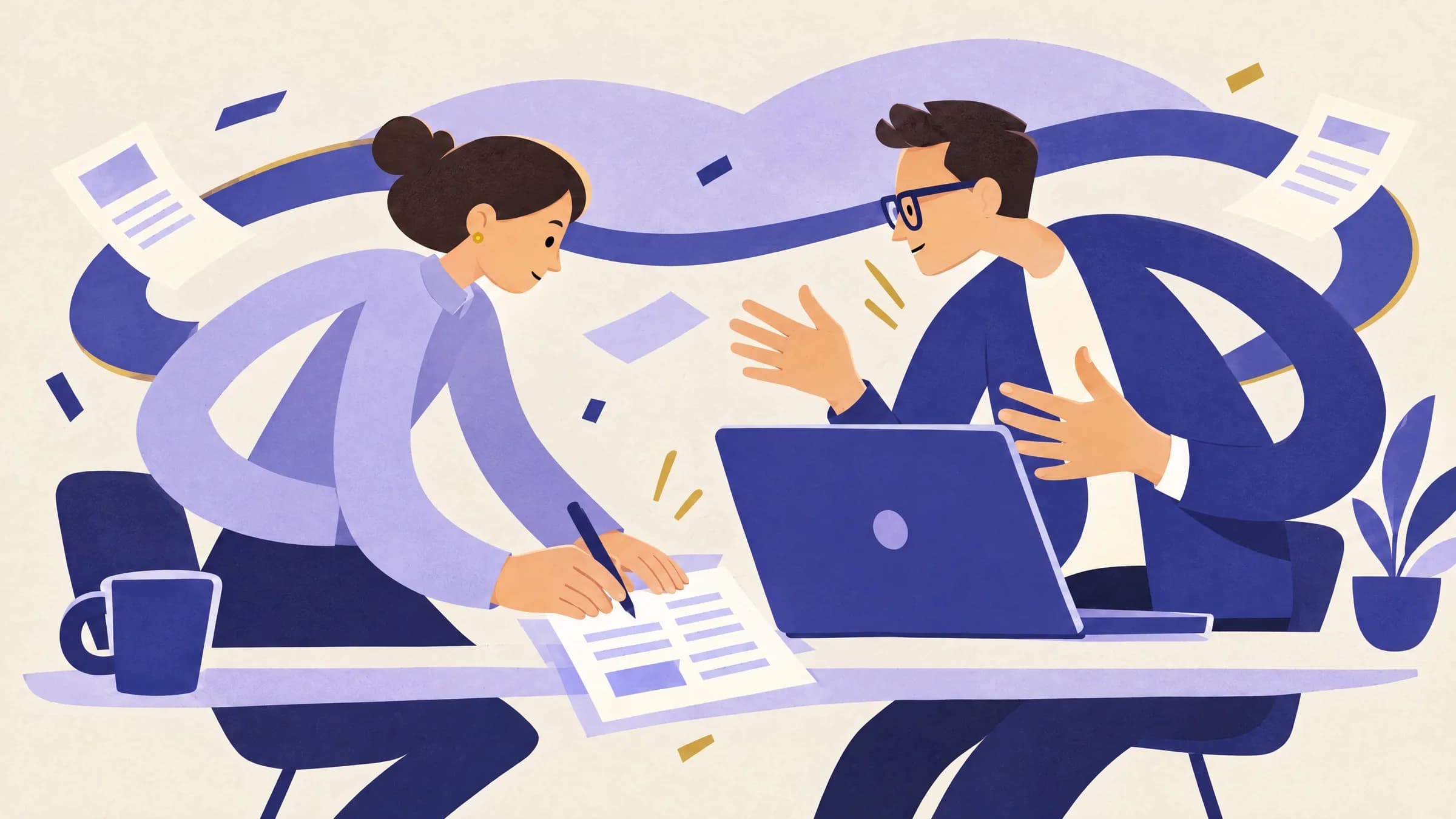
A fair performance review treats AI as part of how work gets done. It rates the quality of the output and the judgment behind it. It does not reward or punish the tool itself. Three rules matter most. Set expectations before the review period. Collect the same evidence for everyone. Never mark someone down for permitted AI use they disclosed.
Why hidden AI use is the larger risk
Many employees already conceal their AI use. A 2025 study by the University of Melbourne and KPMG surveyed more than 48,000 people in 47 countries (KPMG). It found that 57% of employees hide their AI use and present AI output as their own work. The same study found that 66% rely on AI output without checking its accuracy, and 56% have made mistakes in their work because of AI.
The reasons are partly social. Microsoft and LinkedIn's 2024 Work Trend Index asked people who use AI at work about disclosure. 52% were reluctant to admit using it for their most important tasks. And 53% worried that using AI on important work makes them look replaceable (Microsoft).
A review process that penalizes disclosure teaches people to hide. Hidden use is the use a manager cannot coach, check or correct. The goal of the review design is to make honest disclosure the safe choice.
Rule 1: set expectations before the period starts
An employee cannot meet a standard they were never told about. Before the review period, write down three things for each team:
- Which AI tools are approved, and for which kinds of work.
- What must be disclosed, to whom, and how. A one-line note in the document or ticket is often enough.
- What the person must check before AI-assisted work leaves their hands, such as figures, citations, names or customer data.
The team AI use policy template and the AI use disclosure template cover these points. Record which version of the policy applied during the period. A review should judge conduct against the rules in force at the time.
Rule 2: rate the work, then the judgment
Keep the existing performance criteria. Quality, accuracy, timeliness and impact still apply to AI-assisted work. Then add a small number of observable behaviors about how the person uses AI. Each one should be something a manager can see in the work itself.
- Checking: errors in AI-assisted work are caught before others see them.
- Context: the person gives the tool the brief, data and limits it needs, so output needs less rework.
- Data care: confidential and personal data stays out of unapproved tools.
- Fit: the person chooses where AI helps and where it does not, and can explain the choice.
- Sharing: the person passes useful prompts, checks or workflows on to the team.
The AI skills matrix describes these behaviors at four levels. Managers can use its wording so ratings mean the same thing across teams. For how to observe each behavior, see how to assess AI skills.
Rule 3: never penalize permitted, disclosed use
Separate three situations. They call for different responses.
- Permitted use, disclosed: judge the output on its quality like any other work. Speed gained through AI is a result, not a shortcut.
- Permitted use, with an error that reached a customer or colleague: treat it as a quality issue, the same as an error made without AI. Ask what check would have caught it.
- Use that broke the policy, such as customer data pasted into an unapproved tool: handle it through the normal conduct process, citing the policy clause.
Do not rate on enthusiasm for AI. "Embraces AI" rewards visibility, not skill. Do not mark people down for choosing not to use AI on a task where it adds little.
Questions for the review conversation
- Which tasks did you use AI for this period, and which did you choose not to?
- Show me one piece of AI-assisted work. What did you check before it went out?
- Did AI cause an error that reached anyone? What did you change afterward?
- What would help you use AI better next period: a tool, training or time?
Collect the same evidence for everyone
Ratings about AI use rest on examples, like any other rating. Use the same kinds of evidence for every person on the team.
- Two or three dated work samples, with the person's own note on how AI was used and what they checked.
- Any errors that reached others, with the date and what was fixed.
- Training completed and tools provided during the period.
- Any skills assessment taken, with the date and the result.
Account for access. The KPMG study found that only 47% of employees had received AI training, and only 40% said their workplace had generative AI guidance (KPMG). Do not rate someone down on a skill the organization never taught, or on a tool their role was never given.
When AI writes or scores the review
Some managers draft reviews with AI, and some HR systems score staff automatically. Two cautions apply.
First, the manager owns every sentence. Check each claim against the evidence file before it reaches the employee. Keep employee records out of tools your organization has not approved for personal data.
Second, the law may apply. Since January 1, 2026, Illinois has barred AI use with a discriminatory effect in decisions on promotion, discipline, discharge or tenure. The Illinois Human Rights Act treats it as a civil rights violation. It also requires employers to notify employees when they use AI for those purposes (Illinois Public Act 103-0804). The Illinois AI employment law guide covers the details. This is general information, not legal advice.
A checklist for the next review cycle
- Publish approved tools, disclosure rules and required checks before the period starts.
- Record the policy version in force.
- Keep existing quality criteria, and add three to five observable AI behaviors.
- Use shared level descriptions so ratings mean the same thing across teams.
- Collect the same evidence types for every person.
- Apply the disclosure test to each rating.
- Check any AI-drafted review against the evidence before it is shared.
Managers carry most of this work. AI training for managers covers how to prepare them to review AI-assisted work and coach their teams.
Turn reading into practice
Try one small task.
Map a small recurring task as input, draft, human review, and action. Name one failure you would test with fictional data and the condition that would make you stop.
Use fictional or permitted information. Notes stay in this page and disappear on reload; nothing is submitted or graded.
Sources
- Global study reveals trust of AI remains a critical challenge reflecting tension between benefits and risks. KPMG and the University of Melbourne, .
- 2024 Work Trend Index Annual Report: AI at Work Is Here. Now Comes the Hard Part. Microsoft and LinkedIn, .
- Public Act 103-0804 (HB 3773). Illinois General Assembly, .
Researched and drafted with AI. Checked against the sources above and approved for publication by Emeri’s editor. Read our editorial standards.
Get Emeri Weekly
A practical AI method, a worked example, and a task to try in your working week. One email a week.
We email you once to confirm. Unsubscribe in one click from any issue. See our privacy policy.
Related reading

Guide
Can you use AI in a job application? What employers allow at each stage
Most employers that publish rules allow AI for preparation and polishing written materials, and ban it in live interviews and tests unless they say otherwise. Here is how the rules differ.
Guide
How to write an AI policy for employees: sections and plain-language rules
A good AI policy for employees fits on two pages and answers four questions: which tools, which data, who checks the work, and who to tell when it goes wrong. Here are the sections and sample rules.
How-to
Use AI as your editor, not your ghostwriter
AI-written prose tends to sound like everyone else’s. Write the draft yourself, then use the model to find what to fix. Here is a method, with the prompts.