How to prove AI skills to an employer
Show the work, the check and the result. Four kinds of evidence a hiring manager can inspect, how to prepare each one, and what to avoid.
5 min readEmeri editorial
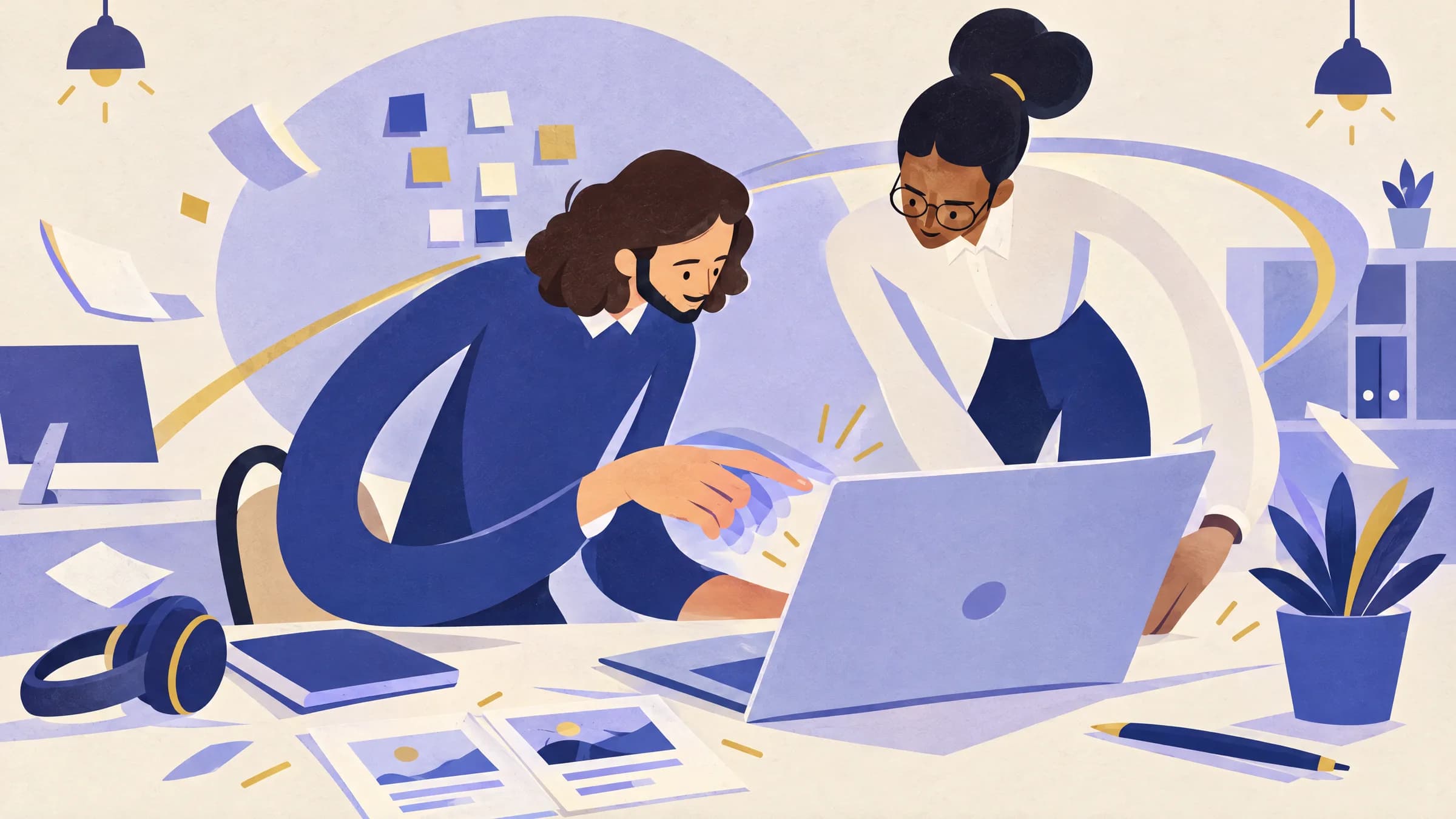
To prove AI skills, give an employer something to inspect, not a claim to accept. Four kinds of evidence work. A work sample shows your process. A before-and-after comparison shows the result. An assessed credential shows a test result an employer can verify. A reference confirms what you did. The strongest case uses two or three of these, each pointing to the same skill.
Why a claim on its own is not enough
Employers find AI skills hard to judge. In a September 2026 survey of 3,128 US hiring professionals for Western Governors University, 60% said AI is making it harder to evaluate candidates’ real skills. The share still working out how to evaluate AI skills doubled in a year, from 16% to 32% (WGU).
Self-reported AI skills are also common. Microsoft and LinkedIn’s 2024 Work Trend Index found a 142-fold rise in LinkedIn members adding skills such as ChatGPT and Copilot to their profiles (Microsoft WorkLab). When everyone lists the same skill, the list stops telling a reader much.
Without better evidence, hiring managers fall back on proxies. Harvard Business School and the Burning Glass Institute studied this in 2024. They found that managers under time pressure tend to rely on stand-ins, such as degrees. They do this instead of assessing a candidate’s skills directly (Burning Glass Institute). Your job is to make the direct assessment easy.
1. A work sample that shows your process
A work sample is the most direct evidence. It shows a real task, the way you used AI on it, and the checks you ran. Build one in five steps:
- Pick a task that matches the job you want, such as a report, a customer reply set or an analysis.
- Remove anything confidential. Replace client names, figures and internal details with realistic stand-ins, or rebuild the task on public data.
- Show your input: the instructions and the source material you gave the model.
- Show the AI output next to your final version, and mark what you changed and why.
- List the checks you ran, such as figures traced to the source, claims verified, or tone reviewed.
Emeri’s context brief and output verification checklist templates give a structure for the input and the checks. Build an AI work portfolio covers how to collect several samples.
2. A before-and-after comparison
A before-and-after comparison shows what changed when you added AI to a task. Measure something you can explain:
- Time: hours per weekly report before and after.
- Volume: tickets, drafts or records handled per week.
- Quality: errors caught in review, or rework requested by others.
- Reach: other people who now use the process you built.
Say how you measured. “Across six weekly reports, my draft time fell from about four hours to about two” is a claim a manager can question and you can defend. Do not round up, and do not count time the AI saved if you then spent it checking the output.
3. An assessed credential
A credential helps when it records an assessment, not attendance. The Institute for Credentialing Excellence separates a certificate of attendance, which requires no proof of learning, from credentials that test what the holder can do (ICE). The second kind is evidence. The first shows interest.
Give the employer a way to check it. Microsoft lets you share a verifiable credential from your Learn profile, which must be public for others to verify it (Microsoft Learn). Coursera certificates carry a verification link and state that Coursera checked your identity (Coursera). Course certificate vs skills assessment explains how to tell the kinds apart.
4. A reference who saw the work
A reference can confirm what a work sample cannot: that you did the work, in a real job, with real stakes. Ask a manager or colleague who saw you use AI on a specific task. Tell them which task you will mention, so they can speak to it. A reference who says “she built our AI-assisted reporting process and trained two others on it” carries more weight than general praise.
Where to put the evidence
- Resume: one experience bullet per skill, with the result, and a link to your portfolio or credential.
- Portfolio page: two or three work samples, each with the input, the output, your edits and your checks.
- Application questions: a short before-and-after example when a form asks how you use AI.
- Interview: the example you can rerun, plus the name of a reference who saw the work.
Use the same example in each place. A reader who sees one task described on the resume, shown in the portfolio and explained in the interview has three reasons to believe it.
What hiring managers check
Whatever evidence you bring, expect questions on these points:
- How you check output: what you verify, and what you do when the model is wrong.
- How you protect data: what you will and will not paste into an AI tool.
- When you do not use AI: tasks where you decided it was the wrong tool.
- Whether you can do it live: some employers set a short task in the interview.
What to avoid
- Sharing confidential material from a current or past employer, even in a private portfolio.
- Presenting AI output as wholly your own work.
- Showing only the final version. The process and the checks are the evidence.
- Claiming results you cannot explain, such as a percentage with no baseline.
For how to describe these examples out loud, see how to talk about AI in a job interview.
Where Emeri fits
Emeri sells an AI proficiency certification, so weigh this comparison with that in mind. The free check takes about 15 minutes and shows where you stand across six skills. Emeri certification is assessed on real work tasks and reported as a band from E1 to E4 (bands). An employer can open the verification link without an account. A credential works best beside a work sample, not in place of one.
Sources
- AI has made real skills harder to evaluate. Western Governors University, .
- Skills-Based Hiring: The Long Road from Pronouncements to Practice. Burning Glass Institute and Harvard Business School, .
- AI at Work Is Here. Now Comes the Hard Part (2024 Work Trend Index). Microsoft and LinkedIn, .
- Certificate vs Certification. Institute for Credentialing Excellence, .
- Sharing and validating of Microsoft Credentials. Microsoft Learn, .
- What Is Coursera?. Coursera, .
Researched and drafted with AI. Checked against the sources above and approved for publication by Emeri’s editor. Read our editorial standards.
Every piece we publish is tried on real work and scored against the Emeri standard. See where your own skills stand with the free 15-minute check.
Get Emeri Weekly
AI for business, tested on real work. New tools, releases and how-tos, each tried on a real task and scored. One email a week.
We email you once to confirm. Unsubscribe in one click from any issue. See our privacy policy.
Related reading
Guide
AI skills to put on your resume, with example bullets by role
Name the task, the tool and how you checked the output. Here are AI skill phrases and example resume bullets for eight roles, plus how to match the wording an employer searches for.
Guide
AI certification cost in 2026: prices, retakes and renewal fees
AI certifications cost from nothing to about $800 for the exam. Retakes, subscriptions and renewal fees can add more. Here are the October 2026 prices from each issuer.

Guide
AI certifications for banking: ABA courses, GARP RAI and the 2026 model risk rules
Bankers can take ABA's four-week AI courses or GARP's exam-based RAI Certificate. Model risk guidance changed in 2026 and now leaves generative AI to each bank's own governance.